Chromatography gets its name from the (sometimes) colourful chromatograms it produces.
Chromatography is a method used for separating ( and identifying) components of a mixture based on how they interact with two phases :
1. Two Phases
- Stationary phase: stays fixed (solid or a liquid coated on a solid).
- Mobile phase: moves through the stationary phase (liquid or gas).
Separation happens because different substances interact differently with these two phases.
2. Differential Distribution
Each component distributes itself between the stationary and mobile phases to a different extent.
- Components with greater affinity for the stationary phase move more slowly.
- Components with greater affinity for the mobile phase move faster.
3. Adsorption / Partition
Depending on the type of chromatography:
- Adsorption chromatography (e.g., column, TLC): separation is due to different degrees of adsorption onto a solid stationary phase.
- Partition chromatography (e.g., paper, gas-liquid): separation is due to different solubilities between two liquid phases.
4. Rate of Migration
Because of different interactions, components travel at different speeds, leading to separation into distinct bands or spots.
5. Reversibility
The interactions between solute and stationary phase are reversible, allowing continuous movement and separation.
6. Detection and Identification
Separated components can be:
- Detected visually (color, UV light)
- Identified quantitatively (e.g., Rf value in TLC, retention time in GC/HPLC)
Paper Chromatography
Paper chromatography is a relatively simple and economic separation technique used to separate and identify mixtures of soluble substances, such as inks, dyes, amino acids, or food colourings.
Different substances in the mixture being analysed move at different speeds up the paper because they have different attractions to the paper (stationary phase) and the solvent (mobile phase).
Gas Chromatography (GC)
Gas chromatography is used to separate and identify substances that can be vapourised.
A mixture is heated and turned into a gas.
The substances in the mixture move through a column at different speeds, so they separate.
- Mobile phase: inert gas
- Stationary phase: liquid on a solid inside the column
Retention time: time taken for a substance to pass through the column . This (value) is used to identify the individual components in the mixture.
Here MACHEMGUY gives a very thorough and clear explanation of how GC works.
- What is the carrier gas for?
- When the stationary phase is solid what mode of separation applies?
- Why does this lead to separation of the mixture?
- What is the retention time and why is it significant?
- When the stationary phase is liquid how is separation achieved?
- What is the significance of the peak areas in the spectrum produced by GC?
- What are the limitations of GC as an analytical technique?
- What is the carrier gas for? It moves the components of the mixture through the column enabling separation
- When the stationary phase is solid what mode of separation applies? Adsorption
- Why does this lead to separation of the mixture? Some components are adsorbed more strongly than others and therefore are slowed down
- What is the retention time and why is it significant? The time taken from injection to detection. This is specific to particular substances and can be used to identify the component by comparison with known data.
- When the stationary phase is liquid how is separation achieved? Relative solubility enables separation
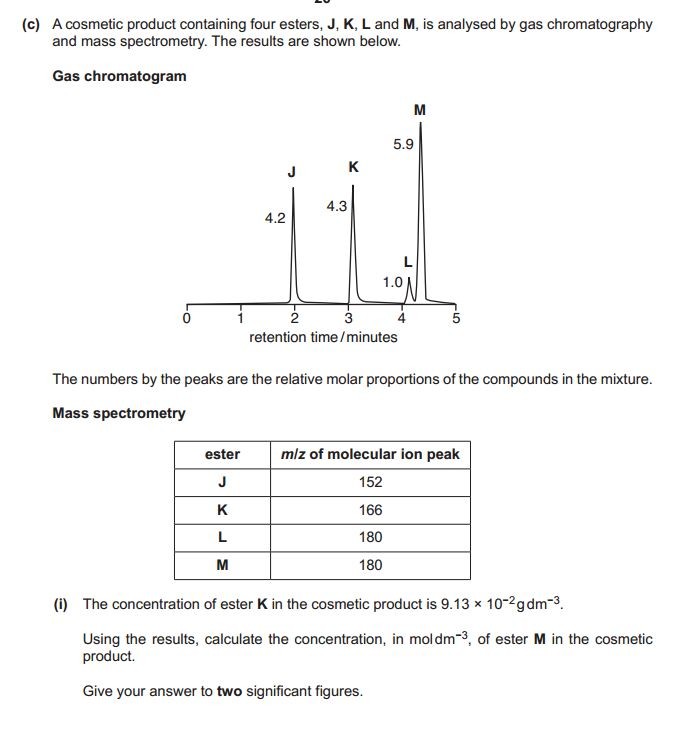
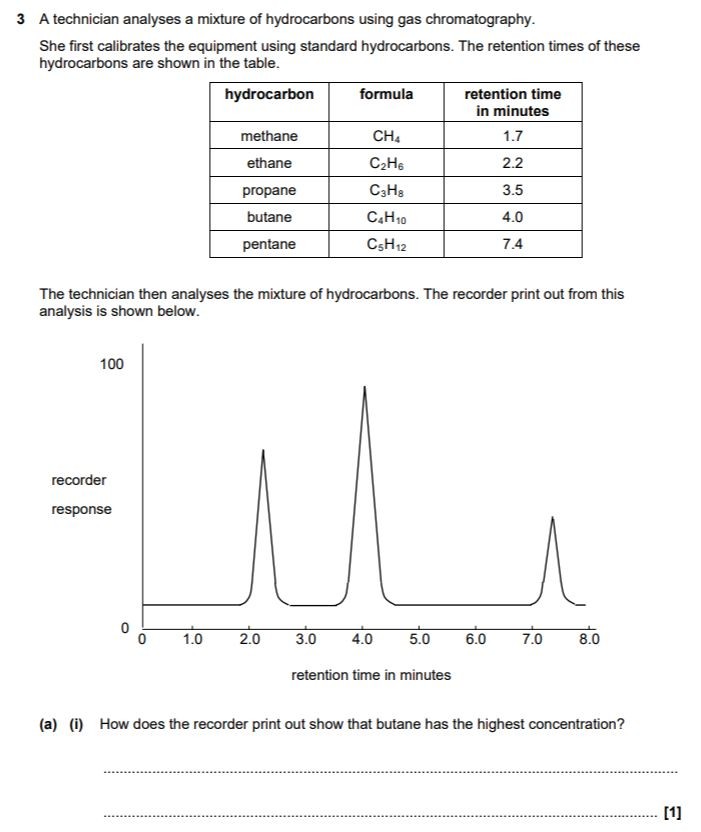
- What is the significance of the peak areas in the spectrum produced by GC? The area under the peak shows relative amounts of the substances in the mixture.
- What are the limitations of GC as an analytical technique? Some substances have the same RT values and unknown substances have no RT values.
- How is this problem addressed? By linking Mass spectrometers to GC - using GC to separate and then MS to identify. (GC-MS)
.
High performance liquid chromatography ( HPLC)
Watch this video to see how the retention times can be to identify the components in a mixture and how the areas of the peaks produced by the instrument can be used to determine the relative concentrations of each component.
A visual overview of chromatographic methods
Questions to try